
Walthall County Criminal Court Records
A Walthall County criminal court record is the case file the clerk of court opens once a prosecutor formally charges a person with a crime. It is different from an arrest or booking entry. A booking note is created the moment someone is jailed, but the criminal court record begins when charges are filed in court and then grows with every docket entry until the case closes. In Walthall County, felony case files are kept by the Circuit Clerk, Dan "Nut" Hawn, at the Walthall County Courthouse, 200 Ball Avenue in Tylertown. As a case moves forward, that file collects the indictment or information, the arraignment entry, pleas, motions, hearing orders, the verdict or plea agreement, and the final sentencing order. The record is the official account of what the court decided, not simply what an arresting officer first alleged.
Criminal cases in Walthall County are split among several courts by the seriousness of the offense. Felonies are prosecuted in the Walthall County Circuit Court, which sits in Mississippi's 14th Circuit District and handles felony prosecutions, civil lawsuits, and appeals from the lower courts. Misdemeanors and traffic offenses outside the city limits run through Justice Court at 807 Magnolia Avenue, while municipal misdemeanors, city ordinance violations, and city traffic move through Tylertown Municipal Court. Many felonies begin with an initial appearance, a bond hearing, and a preliminary hearing in Justice or Municipal Court, then move up to Circuit Court after a grand jury returns an indictment. For a closer look at the underlying allegations themselves, the Walthall County arrest and charge records trace the charging side, while the criminal court file tracks the case from filing to sentence.
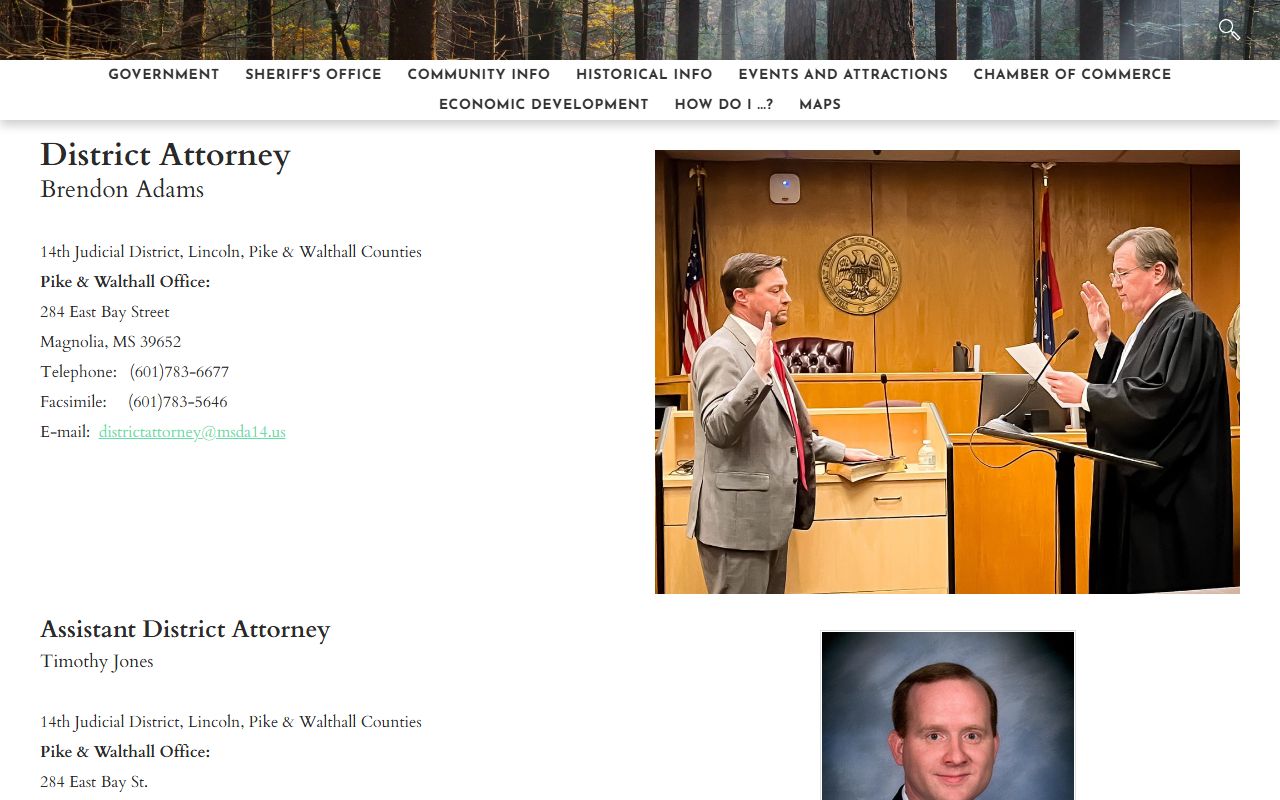
The 14th Judicial District Attorney decides which formal charges open a Circuit Court case, presents felony matters to the grand jury, negotiates pleas, and appears at sentencing. The local district attorney page lists District Attorney Brendon Adams and Assistant District Attorney Timothy Jones, whose Pike and Walthall prosecution office is at 284 East Bay Street in Magnolia, Mississippi, reachable at 601-783-6677. Note that this Magnolia office is in a separate town and is not the same as Magnolia Avenue in Tylertown.
Because the prosecutor, not the arresting agency, sets the charges that appear in the court file, a person may be arrested on one set of allegations and later be formally charged, indicted, reduced, dismissed, or diverted. The criminal court record is where those changes are documented in order.
How to Search Walthall County Criminal Court Records
There is no free public online database for Walthall County Circuit Court criminal cases. The most specific local online portal, the Walthall Chancery Court Cases Link hosted by Delta Computer Systems, covers chancery matters on a paid subscription and does not include the Circuit Court felony docket. For criminal case files, the practical path is the Circuit Clerk's office by phone, in person, or by a written public-records request.
- Contact the Circuit Clerk at 601-876-5677, or visit the courthouse at 200 Ball Avenue in Tylertown, Monday through Friday, 8:00 a.m. to 5:00 p.m.
- Give the clerk the defendant's name and the case number if you have it, since name plus case number is the fastest way to locate a file.
- Narrow the request by court level, approximate filing date, and record type so staff pull the right Circuit Court file rather than a Justice or Municipal Court matter.
- Ask staff to confirm the docket entries and the disposition, including the final plea or verdict and the sentencing order.
- Request a plain or certified copy from the clerk if you need the record for legal or official use; reasonable copy fees apply.
Statewide and federal channels round out a criminal search. Mississippi Electronic Courts, the state's electronic-court system, is the official access point for participating courts, though public viewing may require an account and may be separate from the local courthouse terminal. For state-sentenced defendants, the Mississippi Department of Corrections inmate search locates people by name or MDOC identification number after a felony conviction. Federal criminal matters from Walthall County are handled in the U.S. District Court for the Southern District of Mississippi, with Walthall placed in the Eastern Division at Hattiesburg, and are prosecuted by the U.S. Attorney's Office for that district.
The U.S. Attorney's Office for the Southern District of Mississippi handles federal prosecutions that fall outside the county courts.
Federal docket and document access for those cases runs through CM/ECF and the national PACER system rather than the county clerk, so a Walthall County resident may need to check both the county courthouse and the federal court depending on who brought the charge.
Stages of a Walthall County Criminal Case
A criminal case in Walthall County moves through a predictable sequence, and each step leaves its own mark in the court file. Reading the docket in order shows when charges were filed, how the defendant answered, what the court decided, and what punishment, if any, followed. The case flow below maps the main stages, and the table that follows explains where each one appears in the record.
Case flow: Charges Filed › Arraignment › Pretrial / Motions › Plea or Trial › Disposition › Sentencing
| Stage | What Happens |
|---|---|
| Arraignment | The defendant appears, hears the formal charges from the indictment or information, and enters a plea of guilty, not guilty, or no contest. The docket records the plea and any bond conditions set. |
| Pretrial / Motions | Lawyers file and argue motions, exchange discovery, and may negotiate. Suppression motions, continuances, and scheduling orders are entered, and the file shows each hearing date. |
| Plea or Trial | The case resolves by a negotiated plea or proceeds to a Circuit Court jury trial, heard by a twelve-member jury with one or two alternates. The verdict or accepted plea is recorded. |
| Sentencing | After a conviction or plea, the judge imposes the sentence, which may include prison or jail time, probation, fines, court costs, and restitution. The sentencing order closes the active case. |
What a Walthall County Criminal Court Record Shows
A Walthall County criminal court file is a layered record that combines identifying information, charging details, the running docket, and the financial and dispositional outcome. While the exact Circuit Court case-number format is not published online, the file consistently captures the same core fields. The table below walks through the central fields a reader will encounter when reviewing a criminal case record.
| Field | What It Shows |
|---|---|
| Case Number | The unique identifier the clerk assigns to the file, used to pull the docket and any certified copies. |
| Defendant | The name of the person charged, with party role; juvenile matters use initials and are restricted from ordinary public view. |
| Charges | The charge description, statute where included, and felony or misdemeanor classification as set by the prosecutor's charging document. |
| Plea | The defendant's response to the charges: guilty, not guilty, or no contest, recorded at arraignment or in a later plea petition. |
| Disposition | The final outcome of each charge, such as a conviction, dismissal, acquittal, or diversion into a treatment program. |
| Sentence | The punishment imposed after conviction, including incarceration, probation, fines, court costs, and restitution to victims. |
The same file may also carry docket entries for summonses, motions, continuances, hearing orders, and any appeal notice, along with financial fields for bond, fines, and copy fees. Sensitive material such as Social Security numbers, victim-identifying details, and investigative content is redacted before release. For an overview of how this file fits within every other category the county keeps, the Walthall County court records picture connects the criminal docket to civil, chancery, and probate files.
Charges vs. Convictions
Being charged is not the same as being convicted, and a Walthall County criminal court record makes that distinction clear. A charge is an accusation that opens the case; a conviction is a finding of guilt by plea or verdict. The same file can show charges that were dropped, dismissed, reduced, or that ended in acquittal, and a careful reader looks at the disposition for each count rather than assuming the original charge tells the final story.
| Charge | Conviction | |
|---|---|---|
| Stage | Accusation | Verdict or plea |
| Burden of Proof | Probable cause | Beyond reasonable doubt |
| Public Record | Yes | Yes |
Reading Walthall County Dispositions and Sentences
The disposition is the heart of a criminal court record because it states how each charge ended. Common entries include guilty, not guilty, dismissed, nolle prosequi when the prosecutor declines to pursue a charge, nolo contendere or no contest, and deferred or diverted outcomes. A sentence appears only after a conviction or guilty plea and may combine prison or jail time with probation, fines, court costs, and restitution. Reading a sentence carefully means noting whether terms run concurrently or consecutively, whether part of a term is suspended, and what probation conditions apply, since each affects how long the case stays open.
One important alternative outcome in Walthall County is diversion into the 14th Circuit Drug Court, a problem-solving court that serves Lincoln, Pike, and Walthall Counties for crimes tied to drug or alcohol addiction. The 14th Circuit Drug Court program combines treatment, intensive supervision, drug testing, frequent court appearances, incentives, and sanctions in place of a traditional sentence.
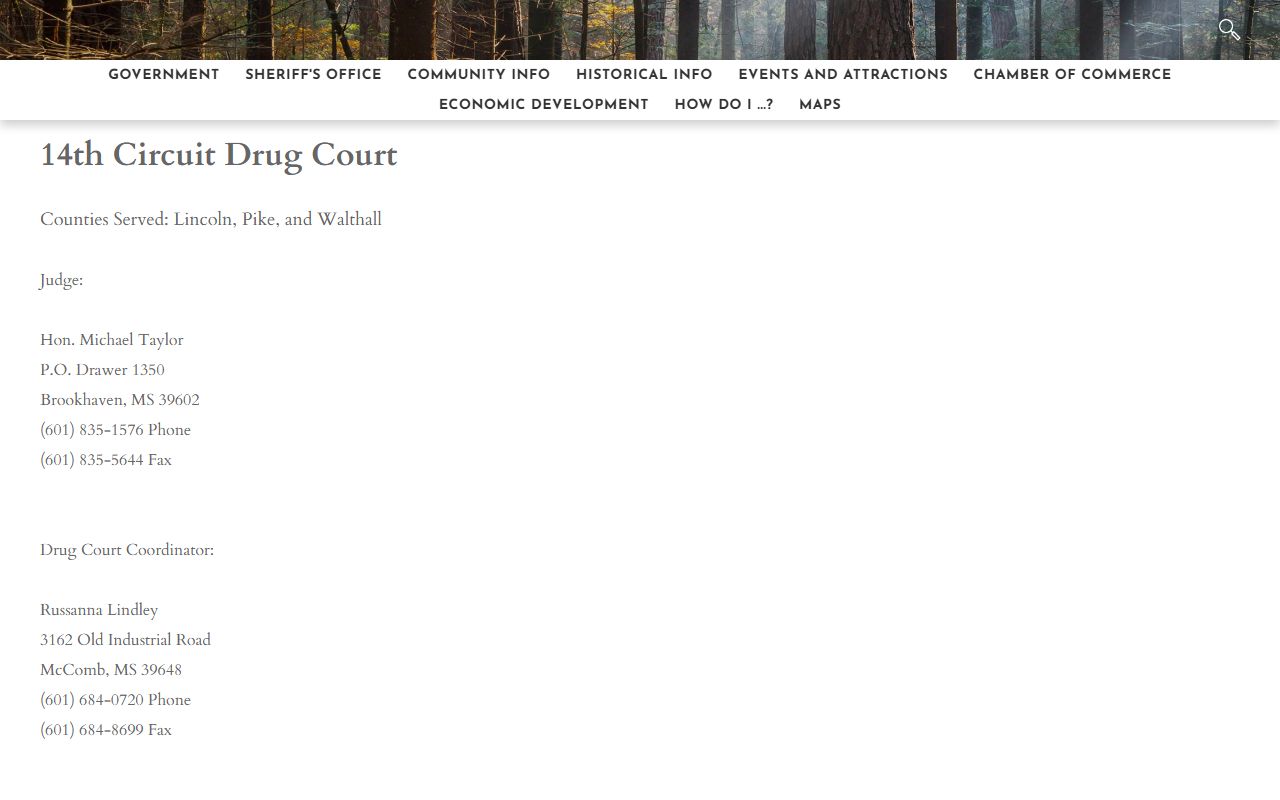
Established February 1, 1999 and recognized in 2024 as the state's oldest felony adult drug intervention court at twenty-five years, the program is led by Hon. Michael Taylor with coordinator Russanna Lindley. When a defendant enters and completes drug court, the criminal court record reflects that diversion path rather than a standard conviction and sentence, so a disposition may read as program completion instead of incarceration.
Sealed vs. Expunged Walthall County Criminal Records
Once a Walthall County criminal record is sealed or expunged, it should no longer be treated like an ordinary public file. A sealed record is restricted from public view but may still be reached by limited parties under law or court order, while an expunged record is removed from public access and, in effect, treated as though the case never happened. Public search results may omit an expunged case entirely or show only limited metadata. Eligibility depends on the offense, the disposition, the time since the sentence was completed, and the court of conviction, and Mississippi law includes offense exclusions and waiting periods.
| Sealed | Expunged | |
|---|---|---|
| Visibility | Hidden from public | Destroyed / treated as never existed |
| Law Enforcement | Limited access | Very limited |
| Eligibility | Set by Mississippi statute and court order; depends on offense and disposition | Filed under Mississippi law in the court of conviction; offense exclusions and waiting periods apply |
A Walthall County expunction starts by identifying the court that handled the case: Circuit Court for felony convictions, and Justice or Municipal Court for many misdemeanors and traffic-level matters. Before calling the clerk, gather the case number, the charge, the disposition, the sentence-completion date, and proof that fines, costs, and probation are paid. If eligible, the petitioner files in the court where the conviction or charge occurred, pays any required filing fee, and notifies the prosecutor or agencies the current law requires. If a judge grants the petition, certified copies of the order may need to go to the Mississippi Criminal Information Center, the arresting agency, the prosecutor, the jail, and the clerk. Do not assume eligibility; confirm the current rules with the court clerk or an attorney before filing, because the statute governing conviction expunction has exclusions and waiting periods.
Public Access to Walthall County Criminal Court Records
Criminal case files in Walthall County are public records under the Mississippi Public Records Act of 1983, which presumes that government records are open for inspection and copying unless a statute, court rule, or court order makes them confidential. The practical rule is to start with the office that maintains the record: Circuit criminal files route to the Circuit Clerk at 200 Ball Avenue, while Justice and Municipal Court misdemeanor files route to those courts. When a record contains exempt material, the agency redacts the exempt portion and releases the rest where it can. Sealed, expunged, juvenile, and victim-identifying records fall outside the ordinary public file.
Key Statutes:
Mississippi Code § 25-61-5 - Gives any person the right to inspect and copy public records under written procedures, and limits delays beyond seven working days without a written explanation.
Mississippi Code § 25-61-7 - Allows agencies to charge reasonable actual-cost fees for searching, reviewing, duplicating, redacting, and mailing records.
Background Check Considerations
Reviewing a single Walthall County criminal court file is not the same as running a formal background check. A casual lookup at the clerk's counter answers a question about one case, but employment, tenant, credit, and licensing decisions are governed by the federal Fair Credit Reporting Act, which requires a regulated consumer reporting agency, written consent, and specific notices. Court files can also be incomplete or out of date between hearings, so anyone making a consequential decision should confirm the current status directly with the court and rely on an FCRA-compliant provider when the law requires one.
Important: This website is not an FCRA-regulated consumer reporting agency, and its information may not be used for credit, employment, tenant, insurance, or other FCRA-covered decisions.
Restricted Criminal Court Records in Walthall County
Some Walthall County criminal matters are not open to the general public. Youth Court files involving juvenile delinquency or abuse and neglect are confidential and accessible only to parties, attorneys, court-authorized people, and agencies under law or court order. Sealed and expunged cases are removed or hidden from ordinary searches, ongoing investigations may withhold investigative reports even when the related incident report is public, and records can be restricted to protect Social Security numbers, financial account details, minor names, victim-sensitive information, and the personal information of officers, judges, and prosecutors. When a file appears blocked or missing, the safest step is to call the court that handled the case, confirm whether the record is restricted or simply not digitized, and ask what lawful access path applies to your role in the matter.